
Saving vs. Investing: What Should You Do First?
The answer to saving vs. investing starts with when you will need the money. Prioritize savings for emergencies and near-term expenses. Consider investing for longer-term goals once your budget, cash reserves, and debt obligations allow you to leave money invested through market declines.
You do not necessarily have to finish saving before you begin investing. Many people need both: accessible cash for unexpected bills and investments for goals that are years away.
Imagine having $500 left after paying this month’s expenses. You could keep it for a possible car repair, put it toward next year’s move, or invest it for retirement. Each choice can be sensible—but each dollar needs a clear purpose.
This guide explains how to choose that purpose, balance competing goals, and build a plan you can maintain.
Saving vs. Investing: The Main Differences
Saving generally means setting money aside with an emphasis on preserving its dollar value and keeping it available. Investing means purchasing assets with the expectation of growth or income while accepting the possibility of losses.
In this guide, “saving” refers mainly to cash and bank deposits. “Investing” refers mainly to securities such as stocks, bonds, mutual funds, and exchange-traded funds, or ETFs.
| Feature | Saving | Investing |
|---|---|---|
| Main purpose | Fund emergencies and planned expenses | Pursue longer-term growth or income |
| Common examples | Savings accounts, money market deposit accounts, bank CDs | Stocks, bonds, mutual funds, ETFs |
| Value fluctuations | Bank deposits do not fluctuate with stock prices | Market values can rise or fall |
| Return | Interest, depending on account terms | Potential income and price gains, with possible losses |
| Access | Depends on transfers and withdrawal conditions | Depends on the asset, settlement, and account rules |
| Main risk to consider | Inflation can reduce purchasing power | Losses can leave you short when you need the money |
Eligible deposits at an FDIC-insured bank receive protection within applicable coverage limits. Stocks, bonds, and mutual funds are not FDIC-insured, even when purchased through an insured bank. www.fdic.gov
Both saving and investing can serve important roles in the same financial plan.
Three Questions to Ask Before Choosing
Before comparing accounts or investment returns, answer these questions.
1. When will I need this money?
A security deposit due in six months requires a different approach from retirement spending several decades away.
Give the goal an expected withdrawal date. If you cannot name a date because the money covers emergencies, ready access should be a priority.
2. Could I postpone the goal if the balance fell?
Suppose your investment declined just before you planned to use it.
Could you delay the purchase, reduce the amount you spend, or cover the difference elsewhere? If the answer is no, you have less capacity to accept investment risk.
3. Do I have separate emergency savings?
A long-term investment plan becomes harder to maintain if every unexpected bill requires selling assets.
Cash reserves give you more flexibility to keep investments focused on their intended goals.
Your timeline, flexibility, and financial cushion are more useful starting points than the return you hope to earn.
A Practical Order for Saving and Investing
There is no universal sequence for every household, but the following framework can help you organize competing priorities.
| Priority | What to do | When to reconsider |
|---|---|---|
| Cover immediate obligations | Fund essentials and required debt payments | Whenever income or bills change |
| Establish a starter cash reserve | Set aside money for plausible financial setbacks | After using the reserve or identifying new risks |
| Address expensive debt | Direct extra payments toward costly balances | As rates, balances, and terms change |
| Fund near-term goals and strengthen reserves | Calculate what upcoming expenses require | When deadlines or costs change |
| Invest for longer-term goals | Choose contributions and investments you can maintain | As your goals, timeline, or circumstances change |
A workplace retirement match deserves consideration alongside these priorities. Depending on its terms and your financial position, contributing enough to receive a match may make sense before completing every other step.
The sequence should help you make decisions without becoming a rigid rule that ignores your circumstances.
When Should Saving Come First?
You have little protection against unexpected expenses
A necessary repair or interruption in income can force you to borrow if you have no accessible savings.
Start with a cash target based on realistic risks: essential transportation, insurance deductibles, household responsibilities, and how predictable your income is.
The CFPB’s emergency fund guide explains that the appropriate amount depends on your circumstances and that even a small reserve can help. www.consumerfinance.gov
For a fuller reserve, three to six months of essential expenses is a planning guideline rather than a requirement for everyone. Someone with unstable income or dependents may need more protection.
Our guide to how much emergency savings you need can help you choose a target. If you are starting from zero, begin with a manageable milestone using our guide to saving your first $1,000.
You have a near-term expense with a firm deadline
Examples include:
- Moving costs due in nine months.
- Tuition payable next year.
- A car replacement you cannot postpone.
- A home down payment for a planned purchase.
- An upcoming medical expense.
Investor.gov cautions against risky investments for goals five years away or less because you may have to sell at a loss when the money is needed. www.investor.gov
Five years is not a guarantee of safety on either side of the deadline. The amount of uncertainty you can accept also depends on how essential and flexible the goal is.
Your budget does not consistently leave money available
Before investing, calculate what remains after essentials, required payments, and predictable irregular expenses.
Annual insurance premiums and necessary maintenance still need funding even when they do not appear on every monthly statement.
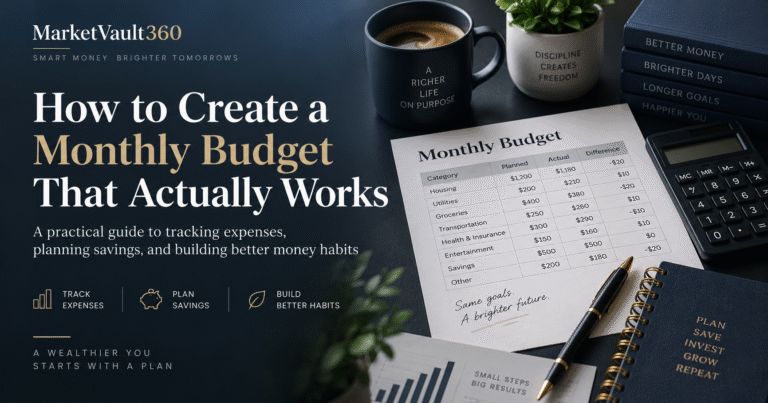
Use our guide to creating a monthly budget that actually works to identify a contribution amount you can sustain.

Where Does Debt Fit Into Saving vs. Investing?
High-interest debt can make additional investing a less attractive use of available money.
Suppose you carry a credit card balance charging 24% APR. You owe that borrowing cost under the account’s terms regardless of whether your investments perform well.
Investment returns are uncertain. Hoping to earn more does not remove the debt expense.
Investor.gov emphasizes paying down credit cards and other high-interest debt when building an investment foundation. www.investor.gov
A practical approach is to maintain required payments, keep a starter cash reserve, and prioritize expensive balances before committing substantial additional money to investments.
Lower-rate loans require a more individual assessment. Review the interest rate, loan conditions, cash needs, and available retirement benefits.
For a closer look at this decision, read Should You Pay Off Debt or Save Money First?
When Does Investing Make Sense?
Investing becomes more appropriate when you have money for a long-term goal and can accept uncertainty along the way.
Before starting, check that:
- Essential bills and required payments are covered.
- You have accessible cash for plausible setbacks.
- Expensive debt is being addressed.
- The money has a sufficiently long timeline.
- You understand the investment and its costs.
A longer investment horizon may give you more flexibility to tolerate market fluctuations, but it does not guarantee profits.
Your risk tolerance includes your ability and willingness to accept losses. Investor.gov identifies both risk tolerance and time horizon as important factors in choosing an investment mix. www.investor.gov
Feeling comfortable with risk does not make next year’s rent available for investing. Your financial capacity matters as much as your confidence.
Consider an available employer match
A workplace retirement match may justify starting retirement contributions while you continue building cash savings.
For example, an employer offering a 50% match on an eligible $100 contribution would add $50 under that hypothetical formula.
Check contribution requirements, eligibility, and vesting—the rules determining when employer contributions become yours to keep. Some plans require a period of service before those contributions fully vest. www.dol.gov
Weigh the benefit against urgent bills, debt costs, and your need for accessible money. Retirement contributions should fit within a workable budget.
Saving vs. Investing: A Balanced One-Year Example
Suppose you have $5,000 and are deciding where to put it.
The table below shows a savings illustration alongside several possible investment outcomes over the same year.
| Hypothetical scenario | Value after one year |
|---|---|
| Savings earning a constant 4% APY | $5,200 |
| Investment gaining 10% | $5,500 |
| Investment with a 0% return | $5,000 |
| Investment losing 20% | $4,000 |
The savings calculation assumes the APY remains unchanged, with no deposits, withdrawals, or fees. Investment figures assume the stated total return, with no additional contributions or withdrawals. All figures exclude taxes and investment costs.
These scenarios are illustrations, not forecasts or equally likely outcomes. Actual investment results can fall outside this range, and savings rates can change.
If this money is for a move next year, a $1,000 loss could disrupt the plan. If it is for retirement decades away, a temporary decline may be more manageable—although recovery is never guaranteed.
The right choice depends on what a shortfall would mean for you.
Why Long-Term Growth Matters
Saving protects your ability to meet immediate needs. For distant goals, you also need to consider how money might grow over time.
Compounding occurs when earnings remain invested and can generate further earnings. It can apply to interest-bearing savings as well as investments, although their risks and return patterns differ.
Consider someone contributing $200 at the end of each month for 20 years, starting from zero.
| Assumed effective annual return | Total contributions | Approximate ending balance |
|---|---|---|
| 0% | $48,000 | $48,000 |
| 4% | $48,000 | $72,768 |
| 7% | $48,000 | $101,507 |
These calculations use constant annual return assumptions converted to equivalent monthly rates. They assume all earnings are reinvested and exclude fees, taxes, and inflation.
The figures are mathematical scenarios, not savings-rate quotes or investment projections. A 7% return is not guaranteed, and real market returns do not arrive smoothly each month.
The example shows how time and retained earnings can affect an outcome. It does not establish that a particular investment will deliver that outcome.
Inflation also matters. A future balance’s purchasing power depends on how prices change, so its dollar value alone does not tell you how much it will buy.

How to Save and Invest at the Same Time
Rather than choosing one permanent percentage, calculate what your goals require.
The following scenarios use a hypothetical $500 monthly surplus after essential expenses, required debt payments, and predictable bills.
Scenario 1: You are building your first cash reserve
You have $300 saved, reliable income, and no expensive debt. After reviewing likely expenses, you choose an initial $1,500 reserve.
You could temporarily direct $500 a month to savings.
After two months, you would have $1,300. Another $200 in the third month would reach your target, ignoring interest and withdrawals.
Then reassess whether to expand your reserve, begin investing part of the surplus, or do both. Consider any workplace match separately rather than automatically postponing it.
Scenario 2: You have a reserve and a planned expense
Your emergency fund is adequate for your circumstances, and you need another $2,400 for a move in 12 months.
Your monthly savings requirement is:
$2,400 ÷ 12 = $200
That leaves $300 a month potentially available for long-term investing, assuming other priorities are covered.
The split comes from the goal’s cost and deadline. It does not need to be 50/50.
Scenario 3: Your income varies
You freelance and have cash reserves, but monthly earnings fluctuate.
A large automatic investment transfer could leave you short during a slow period. A smaller recurring contribution, supported by conservative income estimates, may be easier to maintain.
After reviewing each month’s cash needs, allocate any additional surplus to savings, investments, or debt.
For help choosing an overall target, read how much you should save each month.
Where Should You Keep Savings?
Evaluate access, fees, deposit protection, and interest before choosing an account.
Savings accounts
A savings account can separate reserves from daily spending while keeping money available.
When comparing accounts, check transfer times, minimum balances, fees, and conditions attached to the advertised rate.
Our explanation of how high-yield savings accounts work covers the main features to review.
Certificates of deposit
A bank certificate of deposit, or CD, may suit money you can leave untouched until a known maturity date.
Read the withdrawal conditions. A product that restricts access to money you might need unexpectedly may be unsuitable for that portion of your reserve.
Money market accounts and funds
A money market deposit account is a bank deposit. A money market mutual fund is an investment product.
They have different protections; money market mutual funds do not receive FDIC deposit insurance. Confirm the product type before moving money based on a similar-sounding name. www.investor.gov
How to Start Investing Without Overcomplicating It
Understand the account and what it holds
An investment account is a place to hold assets. Opening or funding it does not necessarily mean you have purchased an investment.
Check whether contributions remain in cash or are invested automatically. Review any default selection to understand what you own.
Look for appropriate diversification
Diversification spreads exposure across investments rather than depending heavily on one company or narrow market segment.
A fund can help, but an ETF or mutual fund is not automatically diversified. A fund focused on one industry can still carry substantial concentration risk. Diversification does not eliminate market losses. www.investor.gov
Compare costs
Review account charges, advisory fees, transaction costs, and fund expenses.
Fees that appear small can have a meaningful cumulative effect on an investment balance, as Investor.gov’s fee guidance explains. www.investor.gov
Choose a sustainable contribution
Use an amount that does not require borrowing or repeatedly taking money from your emergency fund.
A regular schedule can help establish the habit. It cannot guarantee profits, but it can reduce the need to make a new contribution decision every payday.
Common Mistakes to Avoid
Investing money needed for emergencies. Unexpected expenses can coincide with market declines. Maintain a separate accessible reserve.
Leaving every long-term dollar in cash without reviewing the tradeoff. Cash has a useful role, but purchasing power can fall when interest fails to keep pace with inflation.
Treating a calculator’s assumed return as a promise. Use scenarios to explore possibilities, and include less favorable outcomes.
Copying another person’s allocation. Their income, obligations, deadlines, and ability to absorb losses may differ from yours.
Forgetting to update the plan. A job change, upcoming purchase, or emergency withdrawal can change how much you should save or invest next month.
Frequently Asked Questions
Do I need a fully funded emergency fund before investing?
Not always. The appropriate sequence depends on income stability, debt, available retirement benefits, and the risks your household faces.
Some people can build reserves and invest simultaneously. Others benefit from establishing more cash protection first.
Can I start investing with $50 a month?
Potentially, depending on the account’s minimums, available investments, and fees.
Choose an amount your budget supports, and check that charges will not consume a disproportionate share of a small balance.
Is money in a retirement account always invested?
No. The holdings and plan arrangements determine whether the money is invested and in what.
Review your account’s current positions and contribution settings rather than assuming that adding money automatically produces the investment mix you want.
Should I invest a future house down payment?
Consider the purchase date and your ability to postpone it. For a near-term purchase with a firm deadline, a market loss could prevent you from buying as planned.
A distant, flexible goal may allow a different approach. Revisit the risk as the date gets closer.
What if I need money during a market downturn?
An accessible reserve may help you avoid selling investments, but sometimes a withdrawal is unavoidable.
Review the urgency, available cash, account restrictions, and potential taxes or penalties before acting. Keeping essential short-term money separate in advance reduces the likelihood of this conflict.
Your Next-Payday Checklist
To make your own saving vs. investing decision:
- Name each goal. Separate emergencies, planned purchases, and long-term needs.
- Add a deadline and amount. Estimate when you need the money and how much is required.
- Review your cash reserve and expensive debt.
- Calculate each near-term savings contribution. Divide the remaining target by the months available.
- Identify genuinely long-term money. Choose an investment contribution you can maintain.
- Review after meaningful changes. Adjust when income, expenses, deadlines, or reserves change.
Start with one concrete decision for your next paycheck. It might be $200 toward a moving fund and $100 toward retirement, or a temporary focus on rebuilding emergency savings.
A useful plan gives you money for foreseeable needs while allowing you to work toward the future.
This article provides general educational information for U.S. readers, not individualized financial or tax advice. Numerical scenarios are hypothetical, and investment returns are not guaranteed.