Should You Pay Off Debt or Save Money First?
Should you pay off debt or save money first? Start by covering essential bills and minimum debt payments, then build a small emergency cushion. Once you have that protection, prioritize expensive debt. Saving more first may make sense if your income is uncertain or an unavoidable expense is approaching.
Suppose you have $300 left after payday. Putting it toward your credit card reduces interest. Saving it gives you money for the car repair you might otherwise have to charge. Both choices help, but the better next step depends on how much protection you already have.
The goal is to reduce what you owe without leaving yourself one unexpected bill away from borrowing again.
Here is how to decide where your money belongs—and when to change your approach.
Debt or Savings First? A Quick Decision Guide
Use this table to identify your starting point. Except when essential bills are overdue, these priorities concern money left after necessary living costs and required payments.
| Your situation | A reasonable priority | Why it matters |
|---|---|---|
| You are behind on essential bills | Stabilize housing, utilities, food, and transportation; contact creditors | Immediate consequences can outweigh interest-rate differences |
| You have no accessible savings | Build a starter reserve while making minimum debt payments | A small setback should not automatically require new borrowing |
| You have a cash cushion and expensive credit card debt | Direct most extra money toward the highest-rate balance | Reducing costly debt can substantially lower interest charges |
| Your income is irregular or your job is at risk | Strengthen cash reserves while maintaining required payments | Available cash can help cover an income gap |
| You have manageable, lower-rate debt | Balance savings goals with repayment | Paying everything off early may leave other needs underfunded |
| A promotional financing period is ending | Review the terms and fund a payoff plan | The deadline may change which balance needs attention first |
An overdue rent payment and a credit card balance are different problems. Address immediate risks before optimizing your interest costs.
1. Work Out How Much Money Is Actually Available
Before deciding where extra money should go, confirm that it really is extra.
Start with monthly take-home pay. Subtract essential expenses, required debt payments, and reasonable allowances for predictable costs that do not arrive every month. Car registration, annual insurance premiums, and necessary maintenance still belong in your budget.
For example:
| Monthly budget item | Amount |
|---|---|
| Take-home income | $3,600 |
| Essential living expenses | −$2,600 |
| Minimum debt payments | −$250 |
| Money reserved for predictable irregular bills | −$150 |
| Available for additional saving or debt repayment | $600 |
These figures are hypothetical. The useful number is the $600 remaining after existing commitments.
If you need help finding that number, follow our guide to creating a monthly budget that actually works.
If the result is negative, an aggressive payoff schedule is premature. Review spending, income opportunities, and available assistance. Contact creditors about payment difficulties.
The Consumer Financial Protection Bureau recommends weighing the consequences of missed payments and speaking with creditors about possible arrangements when you cannot cover every bill. www.consumerfinance.gov
2. Give Yourself a Cash Cushion Before Aggressive Repayment
Imagine you have $800 in savings and $4,000 in credit card debt. Sending all $800 to the card lowers your balance immediately. But if a necessary $600 car repair follows, you may have to borrow again.
That does not make the original payment pointless. It shows why a debt plan needs room for real life.
The CFPB’s emergency fund guide explains that even a small reserve can provide protection and that an appropriate amount depends on your circumstances. www.consumerfinance.gov
How much should your starter fund hold?
Choose a first target around a plausible near-term expense.
For one person, $500 may cover the most likely disruption. Another might need $1,500 for essential transportation or an insurance deductible. These are illustrative milestones, not universal recommendations.
Ask yourself:
- What necessary expense could realistically arrive before my next paycheck?
- How secure is my income over the next few months?
- Does anyone else depend on my earnings?
- How quickly could I rebuild cash after using it?
A household with two independent, reliable incomes may accept a smaller initial reserve than a freelancer supporting children.
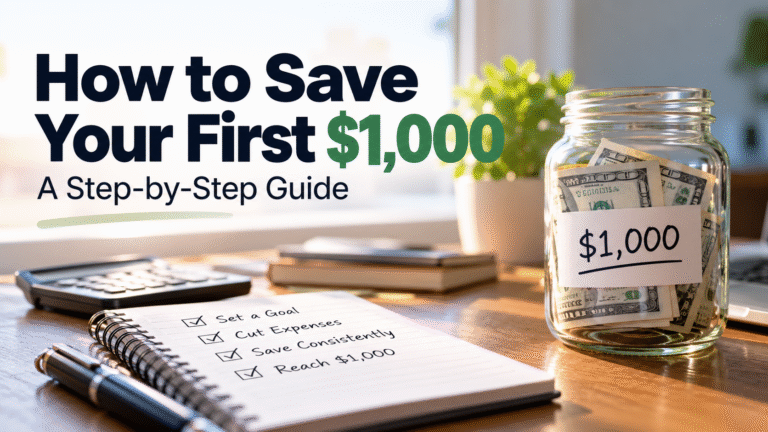
Our guide to saving your first $1,000 can help you turn an initial target into manageable steps. Adapt that milestone to your needs rather than treating it as a finish line.
Keep money for known upcoming bills separate from emergency savings. If you already owe a $900 insurance premium next month, that $900 is committed money.
3. Compare the Cost of Debt With the Return on Savings
Once you have a cash cushion, comparing interest costs can help you decide whether to pay off debt or save money first. Look at what an extra payment would save you and what the same amount could earn in savings over an equal period.
APR, or annual percentage rate, describes an annualized borrowing cost. APY, or annual percentage yield, describes savings earnings with compounding included.
Because they measure interest differently, avoid treating the percentages as perfectly interchangeable. Comparing their effects over the same period gives you a clearer picture.
Example: Paying down a credit card versus saving $1,000
Suppose you have:
- An extra $1,000 beyond your necessary cash reserve.
- A credit card charging 24% APR.
- A savings account paying 4% APY.
Compare both choices over the same 30-day period:
| Use of the extra $1,000 | Approximate benefit over 30 days |
|---|---|
| Reduce an interest-bearing credit card balance at 24% APR | $19.73 in avoided interest |
| Keep it in savings at a constant 4% APY | $3.23 in interest earned before taxes |
The simplified card calculation is:
$1,000 × 0.24 × 30 ÷ 365 = $19.73
It assumes the payment reduces your interest-bearing balance by $1,000 for all 30 days, uses a 365-day basis, and ignores interest-on-interest effects.
The savings calculation is:
$1,000 × [(1.04)^(30/365) − 1] = $3.23
That is approximately $16.50 more benefit from debt repayment over the period, before taxes.
Actual results depend on payment timing, account terms, and interest calculations. Many credit card issuers calculate interest daily, as the CFPB explains. www.consumerfinance.gov
Taxes can widen the gap. Most accessible bank interest is taxable income. At a hypothetical 22% federal marginal rate, $3.23 would leave approximately $2.52 after federal income tax, ignoring state taxes and other effects. www.irs.gov
These are illustrative rates, not current product offers. The comparison supports using surplus cash to reduce expensive debt; it does not establish how much emergency savings you should keep.
What about lower-rate loans?
The choice becomes closer when borrowing costs are lower.
Review the interest rate, remaining term, any prepayment penalty, and how extra payments are applied. Compare the future costs you can actually avoid: upfront fees already paid do not disappear when you repay early.
Cash access also has value. Even if prepayment saves somewhat more than a savings account earns, keeping money for a necessary move or possible employment gap may be reasonable.
4. Pick a Debt Repayment Method You Can Maintain
After choosing how much to allocate to debt, decide which balance receives the extra payment.
Two common approaches are the debt avalanche and debt snowball.
With the avalanche method, you make minimum payments on every debt and put additional money toward the highest-rate balance. Under ordinary fixed-rate assumptions and the same payment budget, this generally minimizes interest costs.
With the snowball method, you make minimum payments on every debt and direct extra money toward the smallest balance. Eliminating an account sooner may help you stay motivated, although it can cost more interest. The CFPB describes the tradeoffs between these approaches in its debt reduction guidance. www.consumerfinance.gov
Consider these hypothetical debts:
| Debt | Balance | APR |
|---|---|---|
| Credit card A | $3,000 | 26% |
| Credit card B | $700 | 19% |
| Personal loan | $5,000 | 10% |
The avalanche method targets card A. The snowball method targets card B.
Neither method means skipping required payments elsewhere.
Deadlines and serious consequences can override the order. An expiring deferred-interest offer or a past-due loan secured by an essential vehicle deserves a separate review.
5. Check Exceptions Before Finalizing Your Plan
A sensible repayment strategy accounts for more than interest rates.
Your employer offers a retirement match
A workplace retirement match deserves attention even during debt repayment.
For example, a hypothetical plan offering a 50% match on an eligible $100 contribution would add $50 from the employer.
Check eligibility, contribution requirements, and vesting—the rules governing when employer contributions become yours to keep. Employer contributions may require a period of service before they vest. www.dol.gov
Consider contributing enough to receive the available match when your budget can support it. Weigh the match and vesting terms against the cost and urgency of your debt.
Retirement money does not replace accessible emergency savings, and essential unpaid bills require immediate attention.
Your debt has promotional terms
A genuine 0% introductory APR and a deferred-interest offer are different arrangements.
With deferred interest, failing to satisfy the payoff conditions can trigger interest dating back to the purchase. Review the agreement carefully rather than assuming that all “no interest” promotions work the same way. www.consumerfinance.gov
Work backward from the deadline.
A $2,400 promotional balance with 12 months remaining would require $200 a month to clear, assuming no interest, fees, or new purchases. Check required payments and aim to finish ahead of the expiration date.
Money earmarked for that payoff is already committed. Do not count it again as emergency savings.
6. Match Your Monthly Split to Your Situation
Whether you should pay off debt or save money first depends on your cash reserves, borrowing costs, and income stability. These three hypothetical scenarios show how the same $600 monthly surplus could serve different needs. Essential spending, minimum payments, and predictable bills are already covered in each example.
These three hypothetical scenarios show how the same $600 monthly surplus could serve different needs. In each case, essential spending, minimum payments, and predictable bills are already covered.
Scenario A: You have no emergency savings
You have a stable paycheck, a credit card charging 24% APR, and no cash reserve. After considering likely repairs and deductibles, you choose an initial $1,200 savings target.
One possible approach is to allocate:
- $400 a month to savings.
- $200 a month to extra credit card payments.
After three months, you would have $1,200 saved, ignoring interest and assuming no withdrawals. You could then direct the full $600 surplus toward the card while maintaining that reserve.
This approach accepts some additional interest expense in exchange for building protection quickly. A different target or split may fit your household better.

Scenario B: Your emergency reserve is already adequate
You have $8,000 in emergency savings, stable employment, essential monthly costs of $2,000, and a $3,000 credit card balance at 24% APR.
You have reviewed upcoming expenses and are comfortable with your four-month reserve.
Directing the $600 surplus toward the card, on top of its required minimum payment, would reduce the balance faster than continuing to grow savings. Once the debt is cleared, redirect the former payment toward your next goal.
You could also consider using part of your existing savings for repayment. Decide how much cash to retain before choosing that option; four months of expenses is not automatically the right amount for everyone.
Scenario C: Your income is irregular
You freelance, have $2,000 saved, and need $2,500 a month for essentials. Your loan charges 7%, and a major client contract ends in two months.
Keeping most or all of the available $600 in savings temporarily may be reasonable while maintaining required loan payments.
Two $600 deposits would increase your reserve to $3,200, before interest or withdrawals—still only about 1.3 months of essential costs.
The priority is covering a possible income gap. Once replacement work becomes reliable, reassess extra debt payments.
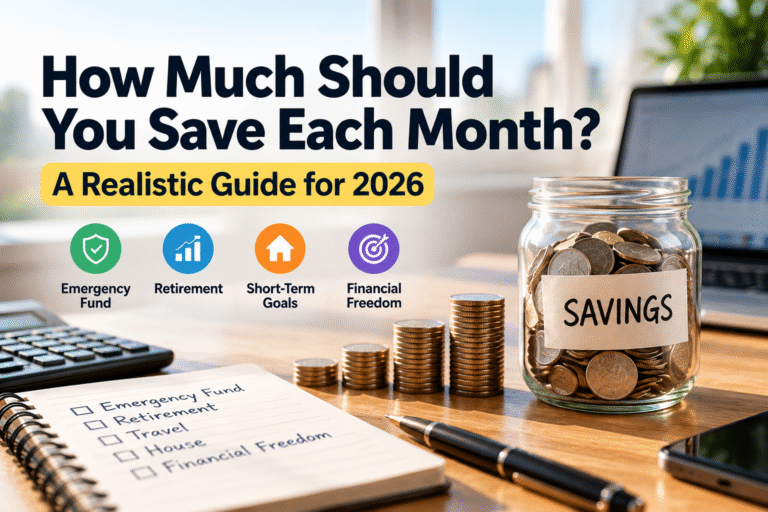
For help choosing a sustainable contribution, see how much you should save each month. Revisit your split whenever your income, expenses, or savings balance changes.
7. Keep Emergency Savings Accessible
Choose an account based on access, fees, deposit protection, and the interest you can earn. Check transfer times before relying on money held at a separate institution.
A high-yield savings account is worth considering when it offers suitable access and terms.
Our explanation of how high-yield savings accounts work covers the basics. If you are deciding whether to switch accounts, our high-yield versus regular savings account comparison explores the differences.
For bank deposits, verify that the institution is FDIC-insured. Standard coverage is $250,000 per depositor, per insured bank, for each account ownership category. Opening another savings account at the same bank does not automatically create additional coverage. www.fdic.gov
Avoid making emergency cash dependent on selling a volatile investment at the right moment. This money needs to be available when a bill arrives.
8. Expand Your Savings After Expensive Debt Is Under Control
When a credit card is paid off, decide where its old payment will go before it disappears into everyday spending.
If you were paying $600 extra plus a $100 minimum, eliminating that balance could free $700 a month, assuming your other commitments stay unchanged.
Redirecting that money can make a larger cash reserve achievable much faster.
A longer-term planning range is three to six months of essential expenses, adjusted for your circumstances. This is a rule of thumb, not a requirement for everyone.
At $2,500 in monthly essentials, that range would be:
| Savings target | Amount |
|---|---|
| Three months of essential expenses | $7,500 |
| Six months of essential expenses | $15,000 |
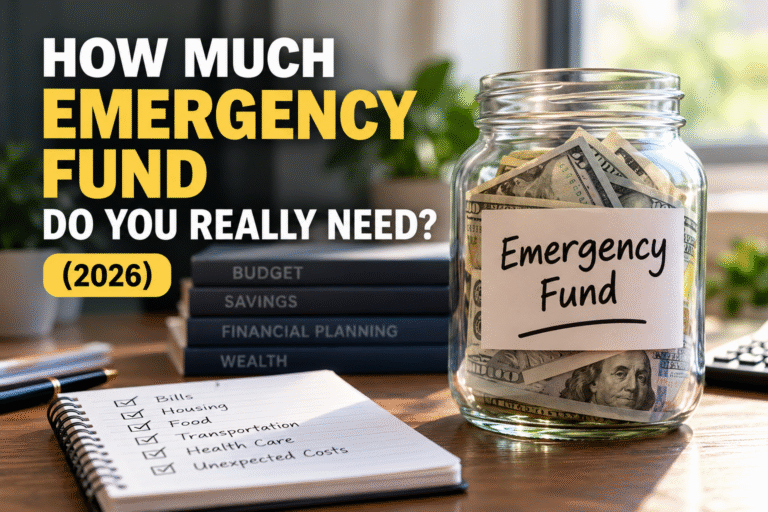
Use our guide to how much emergency savings you need to work through your target. Irregular income or substantial family responsibilities may justify more protection.
You do not necessarily need to eliminate every lower-rate loan before building meaningful savings. Review your goals together as your finances improve.
Our beginner’s guide to managing your money can help you connect debt repayment with your broader financial plan.
Common Mistakes That Slow Your Progress
Draining savings without checking upcoming bills
Before making a lump-sum payment, review the next 60–90 days. Money needed for rent, insurance, or essential repairs is already committed.
A large debt payment should not leave you unable to meet expenses you could have anticipated.
Making minimum payments without a next step
Minimum payments cover the amount currently required, but they are not an accelerated payoff plan.
When cash flow allows, choose a specific extra amount and a target balance. Reassess that amount after raises, expense reductions, or other debt payoffs.
Continuing to add new charges
Track whether your total debt is actually declining.
A $300 extra payment produces little progress if you add another $300 in purchases and do not separately pay those off. Your budget and repayment plan need to work together.
Automating more than your checking account can support
Schedule payments around payday and keep a balance alert.
Automation can make a good plan easier to follow, but the amounts still need to reflect your available cash—particularly if your income varies.
Frequently Asked Questions
Should I use all my savings to pay off credit card debt?
Usually, leave enough accessible cash for necessary bills and a realistic emergency cushion.
Savings above those amounts may be useful for reducing expensive balances. First separate genuine surplus money from cash already committed to upcoming expenses.
Should I save three months of expenses before paying extra on debt?
Not automatically.
Building a large reserve while carrying expensive debt has an interest cost. With stable income, a smaller initial cushion followed by faster repayment may be reasonable. With a likely income interruption, a larger cash reserve may deserve priority.
Is paying off debt better than saving for a house?
Expensive debt often deserves attention before accelerating a down payment. Otherwise, you may build a house fund while paying substantial interest elsewhere.
Keep necessary reserves, assess your total monthly obligations, and avoid assuming that buying sooner always improves your finances.
What if I only have $50 left each month?
Choose a small, specific next step.
If you have no reserve, $50 a month can start building one. If your cash cushion is adequate, it can become an extra debt payment.
If required bills are unaffordable, focus first on assistance, creditor conversations, and closing the budget gap.
Your Debt-and-Savings Checklist
Use this checklist to turn the decision into a plan you can follow this month:
- List every debt: Include its balance, interest rate, required payment, and promotional deadline.
- Calculate your genuine surplus: Subtract essentials, minimum payments, and money for predictable irregular bills.
- Set a cash minimum: Choose the amount you want available before making aggressive extra payments.
- Assign your surplus: Write down the dollar amounts going to savings and your target debt.
- Schedule a monthly review: Adjust after an emergency withdrawal, income change, or debt payoff.
Choose one measurable next milestone, such as “save $400 this month” or “pay $250 extra toward my highest-rate card.”
You can build from there without having to solve every financial goal at once.
This article provides general educational information for U.S. readers, not individualized financial or tax advice. All numerical scenarios are hypothetical.