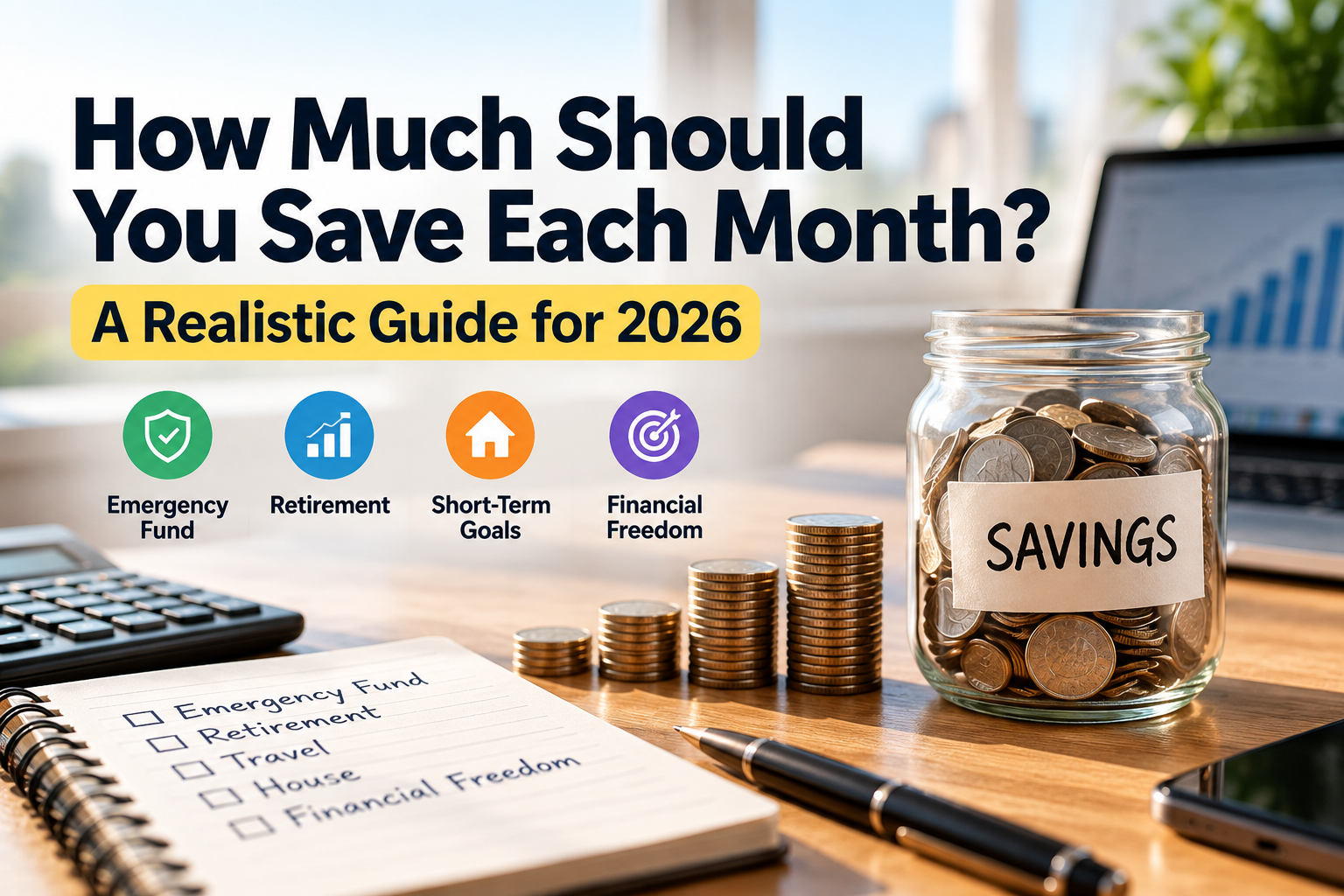
How Much Should You Save Each Month? A Realistic Guide
How much should you save each month?
For many people, 10% to 20% of income can be a useful long-term savings range, but there is no percentage that works for every household.
Someone with expensive childcare, high rent, or credit card debt may not be able to save 20% today. Someone with a high income and low fixed expenses may be able to save 30% or more.
Instead of chasing one “perfect” percentage, build your savings target around three things:
- Money you may need for emergencies.
- Money you are investing for retirement.
- Money you are saving for predictable future expenses and goals.
That approach produces a much more useful answer than simply saying everyone should save the same percentage.
How Much Should You Save Each Month? The Short Answer
If you are looking for a starting point, consider working toward a savings system that includes:
- Emergency savings
- Retirement contributions
- Short-term savings goals
- Sinking funds for irregular expenses
A simple formula is:
Monthly savings target = emergency savings + retirement savings + short-term goal savings
For example, someone might save:
- $200 for an emergency fund
- $400 for retirement
- $150 for a future car
- $100 for travel
That would equal:
$850 per month
The important part is not whether $850 represents exactly 10%, 15%, or 20% of income.
The important question is whether that amount helps you reach your goals without forcing you to borrow money for basic monthly expenses.
Why There Is No Perfect Savings Percentage
Savings advice often sounds much more precise than real life.
You may hear that you should save 10%, 15%, or 20% of your income.
Those percentages can be useful benchmarks, but they are not universal rules.
Consider two households that both take home $5,000 per month.
Household A
Monthly essential expenses: $4,400
Available before discretionary spending: $600
Household B
Monthly essential expenses: $2,800
Available before discretionary spending: $2,200
Telling both households to save exactly $1,000 per month ignores a major difference in their financial situations.
Your savings rate should reflect:
- Income
- Housing costs
- Debt
- Family responsibilities
- Job stability
- Existing savings
- Retirement benefits
- Short- and long-term goals
The best savings target is one that is both ambitious enough to move you forward and realistic enough to maintain.
Start With Your Emergency Fund
Before worrying about maximizing every investment account, make sure you have some cash available for unexpected expenses.
The Consumer Financial Protection Bureau defines an emergency fund as cash set aside specifically for unplanned expenses or financial emergencies and notes that even relatively small amounts can provide useful financial protection.
Examples might include:
- A car repair
- An unexpected medical bill
- A broken appliance
- Emergency travel
- Temporary loss of income
Recent Federal Reserve data shows why this matters.
In the Fed’s 2025 Survey of Household Economics and Decisionmaking, published in May 2026, 63% of U.S. adults said they could cover a hypothetical $400 emergency expense entirely with cash or its equivalent. The same report found that 55% had emergency savings sufficient to cover three months of expenses, while 30% said they could not cover three months of expenses by any means.
You do not need to build a perfect emergency fund immediately.
Start with a reachable first milestone.
A Practical Emergency Savings Progression
One reasonable sequence might look like this:
Stage 1: Build your first $500–$1,000.
Stage 2: Save one month of essential expenses.
Stage 3: Work toward several months of essential expenses.
Fidelity’s current general guideline suggests starting with $1,000 and eventually building toward roughly three to six months of essential expenses. The appropriate amount may be higher for people with dependents, variable income, less-stable employment, or unusually high financial risks.
Treat that as a planning benchmark, not a universal requirement.
Calculate Your Emergency Fund From Expenses, Not Salary
Suppose you earn $6,000 per month but could reduce your spending to $3,500 during an emergency.
Your emergency-fund calculation should generally focus on those necessary expenses.
If essential monthly expenses are:
$3,500
then:
3 months = $10,500
6 months = $21,000
Essential expenses might include:
- Rent or mortgage
- Utilities
- Basic groceries
- Insurance
- Necessary transportation
- Healthcare
- Minimum debt payments
- Essential childcare
You probably would not need to include your normal vacation, restaurant, entertainment, or shopping budget when calculating a bare-bones emergency fund.
Retirement Savings Are a Different Calculation
This is where savings percentages can become confusing.
Emergency savings is generally measured against your monthly expenses.
Retirement savings recommendations are often expressed as a percentage of pretax income.
For example, Fidelity‘s current guideline is to work toward saving at least 15% of pretax income annually for retirement, including employer contributions.
That does not mean every person must immediately contribute 15%.
Someone beginning at 5% and gradually increasing contributions can still be making meaningful progress.
It also means you should avoid directly comparing:
20% of take-home pay for general savings
with
15% of pretax income for retirement
as though they are the same calculation.
They measure different things.
Don’t Confuse Contribution Limits With Savings Targets
Retirement accounts also have annual contribution limits.
Those limits tell you how much you are legally allowed to contribute—not how much you personally need to save.
For 2026, the IRS says the employee contribution limit for most 401(k), 403(b), governmental 457 plans, and the federal Thrift Savings Plan is:
$24,500
The general annual limit across traditional and Roth IRAs is:
$7,500
For people age 50 or older, the 2026 general IRA limit including the catch-up amount is:
$8,600
Eligibility and tax treatment can vary depending on the type of account, income, workplace coverage, and other circumstances.
You do not need to max out a retirement account to be doing well financially.
Consistency matters more than comparing yourself with the legal maximum.
How Much Should You Save Based on Your Income?
Percentages are easier to understand when converted into dollars.
| Monthly Take-Home Pay | 5% | 10% | 15% | 20% |
|---|---|---|---|---|
| $2,500 | $125 | $250 | $375 | $500 |
| $3,500 | $175 | $350 | $525 | $700 |
| $5,000 | $250 | $500 | $750 | $1,000 |
| $7,500 | $375 | $750 | $1,125 | $1,500 |
| $10,000 | $500 | $1,000 | $1,500 | $2,000 |
These numbers are examples—not recommendations for every reader.
If you earn $3,500 and can comfortably save $700, great.
If saving $700 causes you to put groceries on a credit card every month, your savings target is not sustainable.
What If You Can Only Save 5%?
Then start with 5%.
Suppose your take-home income is:
$4,000 per month
Five percent equals:
$200 per month
Over one year:
$200 × 12 = $2,400
That is not insignificant.
More importantly, you have created a repeatable savings habit.
You can later increase that amount when:
- You receive a raise
- You pay off debt
- Your housing costs decline
- Your income increases
- A recurring expense disappears
For example, increasing savings by only $50 per month every six months could gradually move you from:
$200 → $250 → $300 → $350
without requiring an overnight lifestyle change.
What If You Can’t Save Anything Right Now?
If your income is completely consumed by essential expenses, forcing yourself to save an arbitrary percentage may make the problem worse.
Start by understanding your cash flow.
Ask:
Where is my money actually going?
Review your:
- Housing
- Transportation
- Insurance
- Groceries
- Debt payments
- Subscriptions
- Discretionary spending
Our guide on How to Create a Monthly Budget That Actually Works walks through that process step by step.
Sometimes the solution is cutting small expenses.
Other times, the real problem is a much larger fixed expense or insufficient income.
Saving $8 on a subscription will not solve a $600 monthly housing deficit.
Focus on the numbers that matter most.
Save for Predictable Expenses Separately
An emergency fund should not have to pay for expenses you already know are coming.
Suppose you expect:
Car insurance: $1,200 per year
Instead of treating the bill as an emergency:
$1,200 ÷ 12 = $100 per month
Save $100 each month.
You can use the same approach for:
- Car maintenance
- Holiday spending
- Travel
- Annual subscriptions
- Home maintenance
- School costs
- Insurance premiums
- Large planned purchases
These dedicated savings buckets are commonly called sinking funds.
Create a Goal-Based Savings Plan
Instead of asking only:
“What percentage should I save?”
try asking:
“What does each dollar of savings need to accomplish?”
Here’s an example.
Take-home income:
$5,000 per month
Planned monthly savings:
| Goal | Monthly Amount |
|---|---|
| Emergency fund | $250 |
| Home down payment | $300 |
| Car maintenance fund | $100 |
| Vacation fund | $100 |
| Cash savings total | $750 |
The person may also be contributing to a workplace retirement plan directly through payroll.
This structure is much more useful than putting $750 into one generic account called “savings.”
Every dollar has a job.
A More Realistic Savings Example
Imagine Jordan earns a salary and takes home approximately:
$4,500 per month
Jordan’s monthly spending looks like this:
| Category | Amount |
|---|---|
| Housing | $1,450 |
| Utilities and phone | $250 |
| Groceries | $500 |
| Transportation | $350 |
| Insurance/health | $300 |
| Debt payments | $300 |
| Personal/entertainment | $450 |
| Other expenses | $250 |
| Total | $3,850 |
That leaves:
$650 per month
Instead of insisting on a $900 savings target simply because it equals 20% of take-home pay, Jordan could start with the available $650.
For example:
$300 emergency savings
$200 future home fund
$100 sinking funds
$50 additional cash buffer
Total:
$650
Retirement contributions made through payroll would be tracked separately.
Once Jordan pays off debt or receives a raise, the monthly savings target can increase.
That is a savings plan built around reality rather than a rule.
Should You Save or Pay Off Debt First?
This depends heavily on the debt.
Low-rate debt and high-interest credit card debt should not automatically be treated the same way.
If you have expensive revolving debt, directing additional money toward that balance may provide a significant financial benefit.
However, keeping absolutely no emergency savings can create another problem.
A new $500 expense may simply go back onto the credit card.
A practical sequence for some households may be:
- Stay current on essential bills.
- Make all required minimum debt payments.
- Build a small emergency cushion.
- Contribute enough to receive an available employer retirement match, if appropriate.
- Prioritize high-interest debt.
- Expand emergency savings.
- Increase retirement and other investing.
Personal circumstances can change that order, especially where taxes, employer benefits, unusually high interest rates, or unstable employment are involved.
Should Your Employer Match Count Toward Your Savings Rate?
For retirement planning, it can.
If you contribute 10% of pretax income and your employer contributes another 5%, your total retirement savings rate would be:
15%
That is also how Fidelity describes its 15% retirement guideline: employer contributions count toward the total.
But you may still want to track your own contribution separately.
That helps you understand how much of your financial progress depends on your employer benefit.
Where Should You Keep Your Savings?
Different goals require different homes for your money.
Emergency savings
Emergency funds generally need to be:
- Liquid
- Easily accessible
- Relatively stable
A savings account or high-yield savings account may be appropriate for many people.
The purpose is availability—not maximizing investment returns.
Short-term goals
Money you expect to spend within the next few years generally deserves more emphasis on stability and accessibility.
Long-term investing
Money intended for decades in the future may be invested through accounts such as:
- 401(k)
- 403(b)
- Traditional IRA
- Roth IRA
- Taxable brokerage account
The best choice depends on taxes, employer benefits, eligibility, time horizon, and risk tolerance.
Automate Your Savings
One of the easiest ways to make saving more consistent is to make it automatic.
Instead of doing this:
Spend all month → save whatever remains
try:
Get paid → save automatically → spend from the remainder
You might automatically send:
$150 to emergency savings
$100 to a home fund
$50 to a vacation fund
on payday.
Even relatively small transfers become meaningful when they happen consistently.
Increase Savings When Your Income Increases
One of the best opportunities to raise your savings rate is before you get used to spending a raise.
Suppose your monthly take-home pay increases by:
$400
Instead of increasing spending by the full $400, you might direct:
$200 to savings
and keep:
$200 for additional spending
You improve your lifestyle and your finances at the same time.
This is often easier than cutting $200 from a lifestyle you have already become accustomed to.
How to Calculate Your Personal Monthly Savings Target
Use this five-step method.
Step 1: Calculate your take-home income
Find the amount actually available after payroll deductions.
Step 2: Calculate essential expenses
Include necessary housing, groceries, transportation, utilities, insurance, healthcare, childcare, and required debt payments.
Step 3: Choose your financial priorities
For example:
- Emergency fund
- Retirement
- Debt payoff
- Home down payment
- Car replacement
- Travel
Step 4: Calculate each monthly goal
Suppose you want:
$6,000 emergency fund in 24 months
That requires:
$6,000 ÷ 24 = $250 per month
You also want:
$3,600 vacation fund in 18 months
That requires:
$3,600 ÷ 18 = $200 per month
So your short-term savings target becomes:
$250 + $200 = $450 per month
Retirement contributions can then be tracked separately.
Step 5: Compare the target with your budget
If your plan says you need to save $900 but your monthly budget shows only $500 available, something has to change.
You can:
- Extend the timeline
- Reduce the goal
- Reduce spending
- Increase income
- Prioritize one goal before another
That is better than pretending the $900 is affordable.
A Simple Savings Checklist
Before deciding how much to save each month, ask yourself:
- Do I have any emergency savings?
- What are my essential monthly expenses?
- How stable is my income?
- Do I have high-interest debt?
- Does my employer offer a retirement match?
- Am I saving for any large purchases?
- Am I contributing toward retirement?
- Can I automate my savings?
- Could I increase my savings after my next raise?
Your answers matter more than somebody else’s favorite savings percentage.
Frequently Asked Questions
Is saving 10% of my income enough?
It may be a good starting point.
Whether it is enough long term depends on your retirement goals, age, existing assets, expenses, employer benefits, and other savings goals.
Is saving 20% of income good?
Saving 20% consistently can represent strong progress for many households.
But it is not a mandatory benchmark.
A sustainable 10% can be better than repeatedly attempting an unrealistic 20% and then borrowing money to cover expenses.
Should I save from gross or net income?
It depends on what you are measuring.
Household budgeting is often easiest using take-home pay.
Retirement savings benchmarks, however, are commonly expressed as a percentage of pretax income.
Always check which definition a guideline uses before comparing percentages.
How much should I keep in emergency savings?
There is no universal amount.
A commonly used benchmark is several months of essential expenses, with three to six months frequently cited as a planning range. People with variable income, dependents, or less job security may prefer more.
Should I invest all of my savings?
Usually, different money should serve different purposes.
Money for an emergency next week should generally not have the same risk profile as retirement money you do not expect to touch for decades.
Is $500 per month a good amount to save?
It depends on your income and goals.
$500 per month equals:
$6,000 per year
before interest or investment returns.
For one person, that may be an excellent savings rate. For another, it may not be enough to meet long-term goals.
Evaluate it relative to your situation.
The Bottom Line
There is no magic percentage that tells everyone exactly how much to save each month.
Instead, build your savings plan around the jobs your money needs to perform.
Start with emergency savings.
Contribute toward retirement.
Prepare for predictable future expenses.
Then increase your savings rate as your income and financial flexibility grow.
If you can save only $100 today, start with $100.
If you can comfortably save 25% or 30%, there is no reason to stop simply because a popular rule mentions 20%.
The goal is not to win a savings-percentage contest.
It is to create a financial system that consistently leaves more of today’s income available for your future.
This article is for educational and informational purposes only and does not constitute individualized financial, investment, or tax advice.