High-Yield Savings Account vs. Regular Savings Account: What’s the Difference?
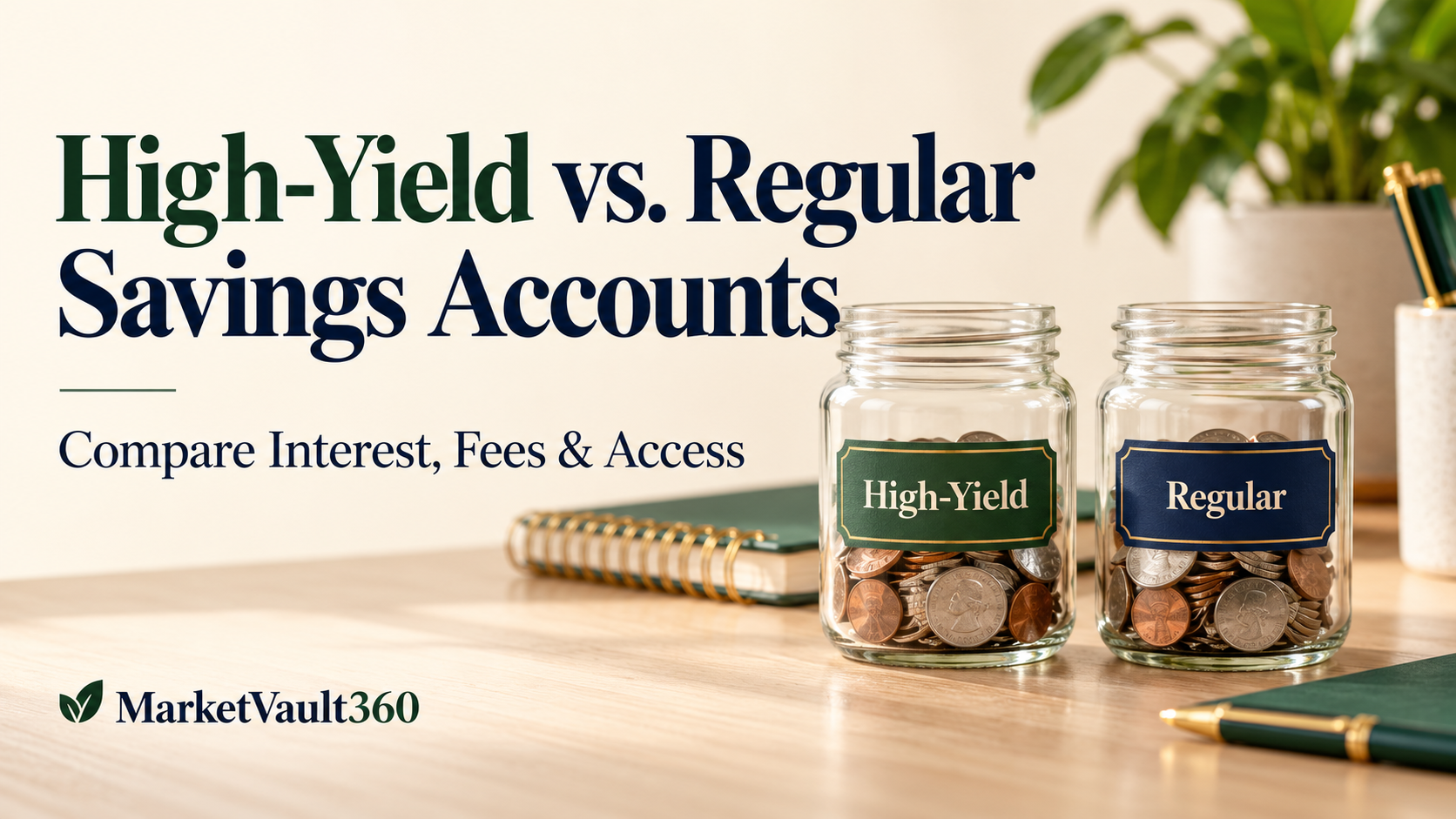
The main difference between a high-yield savings account and a regular savings account is how much interest your money earns. Both are designed to hold savings, but a high-yield account generally offers a more competitive annual percentage yield, or APY.
That difference can matter when you are building an emergency fund or setting money aside for a purchase. However, a higher advertised rate does not automatically make an account the better choice. Fees, withdrawal options, and the requirements for earning that rate can change the outcome.
The useful question is: Which account pays you more after fees while giving you the access you need?
Here is how to compare the two—and decide whether moving your savings is worth the effort.
High-Yield Savings Account vs. Regular Savings Account at a Glance
For this comparison, “regular savings account” means a basic savings account, often offered alongside checking. Individual products vary, so use this table as a starting point rather than a rule for every bank.
| Feature | High-yield savings account | Regular savings account |
|---|---|---|
| Main appeal | A comparatively competitive savings APY | A familiar place to save, potentially alongside checking |
| Interest earnings | Generally higher, depending on the actual offer | May be lower; check your specific account |
| Rate changes | Usually variable | Usually variable |
| Monthly fees | May have none, or conditions and fees may apply | May have none, or require a balance or other condition to waive fees |
| Branch access | Depends on the provider; some accounts are online-only | Depends on the provider; branch-based options are available |
| Cash deposits | Check the available deposit methods | May be available at branches or eligible ATMs |
| Withdrawals | Transfer methods, timing, and limits vary | Transfer methods, timing, and limits vary |
| Federal deposit insurance | Available at an insured institution, subject to coverage rules | Available at an insured institution, subject to the same coverage rules |
| Possible fit | Savings you want to earn interest on between withdrawals | Savings where specific access features justify any lower return |
An account’s name is only a starting point. Compare its current APY, fee schedule, and access options before deciding.
What Actually Makes One Account “High-Yield”?
A high-yield savings account is still a savings account. The label describes its emphasis on interest earnings; it does not mean your money is invested in stocks or locked into a fixed term.
Online banks are one place to look, but “online” and “high-yield” are not interchangeable. An online account is not automatically the best-paying option, and having branches does not automatically make a bank’s savings account uncompetitive.
You may also find more than one savings product at the same institution. Check the APY attached to your exact account—not simply a rate advertised elsewhere on the bank’s website.
For a concrete example of how features can coexist, Ally’s savings account disclosures describe an online savings product with a variable rate and no monthly maintenance fee. That is an illustration of one account’s structure, not a recommendation or a claim that every high-yield account has those terms. Ally Bank®
How Much More Interest Could You Earn?
Translate the difference in APY into dollars. A rate gap can sound impressive while producing a modest dollar benefit on a small balance—or a meaningful benefit on a larger one.
The following examples compare hypothetical APYs of 0.10% and 4.00%. These are illustrations, not current bank offers or national averages.
Assume the money stays deposited for one full year, each APY remains unchanged, all interest stays in the account, and there are no additional deposits, withdrawals, or fees. Figures are before taxes.
| Starting balance | Interest at 0.10% APY | Interest at 4.00% APY | Additional interest at 4.00% |
|---|---|---|---|
| $500 | $0.50 | $20.00 | $19.50 |
| $1,000 | $1.00 | $40.00 | $39.00 |
| $5,000 | $5.00 | $200.00 | $195.00 |
| $10,000 | $10.00 | $400.00 | $390.00 |
| $20,000 | $20.00 | $800.00 | $780.00 |
For the $10,000 example, the calculation is:
$10,000 × (0.040 − 0.001) = $390 more over one year.
Actual earnings change when rates or balances change. If you deposit money gradually throughout the year, each contribution earns interest only for the time it is in the account.
Compare APY with APY
APY includes the effect of compounding—the interest earned on previously earned interest. The stated interest rate alone does not express that full annual effect. The CFPB’s explanation of APY calculations describes how the interest rate and compounding frequency enter the calculation.
If two accounts show the same APY under comparable terms, one does not automatically earn more over a full year simply because it advertises daily compounding. That effect is already reflected in APY.
Also, 4.00% APY is an annual figure. It does not mean you earn 4.00% every month. Consumer Financial Protection Bureau
Fees Can Change Which Account Wins
A higher APY helps only if account costs do not consume the advantage.
Compare these two hypothetical accounts for a $1,000 balance:
- Account A pays 4.00% APY and charges a $5 monthly maintenance fee that you cannot waive.
- Account B pays 3.50% APY and has no monthly maintenance fee.
Using a simplified annual comparison, Account A generates $40 in interest before fees, while its maintenance fees total $60. Account B generates $35 before taxes without that maintenance charge.
Account B comes out ahead. If Account A’s fees are deducted from savings during the year, they also reduce the balance earning interest, making its result slightly worse than the simplified calculation suggests.
Before opening an account, check:
- Monthly maintenance fees and how to waive them.
- Minimum opening deposit and ongoing balance requirements.
- Conditions for the advertised APY, including qualifying deposits or balance tiers.
- Transfer, wire, and excess-transaction fees.
- Any account-closing or promotional-bonus conditions.
These are separate questions. An account can require little money to open while requiring a larger balance to earn its advertised rate.
The CFPB’s Truth in Savings overview identifies APY, interest rates, minimum-balance requirements, and fee schedules among the information covered by disclosure requirements. Read those disclosures before relying on an advertisement. Truth in Savings (Regulation DD)

Are High-Yield Savings Accounts as Safe as Regular Savings Accounts?
For bank-failure protection, what matters is the institution’s insurance status and how your deposits are owned—not whether the account is called “high-yield.”
At an FDIC-insured bank, eligible deposits generally have coverage of $250,000 per depositor, per insured bank, per account ownership category. Both regular and high-yield savings deposits can qualify. See the FDIC’s deposit insurance explanation.
Opening two savings accounts at the same bank does not automatically double your coverage. For example, $200,000 in an individually owned regular savings account plus $100,000 in an individually owned high-yield savings account at the same insured bank would generally total $300,000 in the same ownership category. Under the standard limit, $50,000 would be above coverage, assuming no other relevant deposits or coverage arrangements. FDIC.gov
Federally insured credit unions provide share insurance through the NCUA, also subject to ownership and coverage rules. Check the NCUA’s share insurance guidance when comparing credit union accounts. MyCreditUnion.gov
Insurance against institution failure does not prevent account fees, guarantee a future APY, or stop inflation from reducing purchasing power. Verify the actual institution holding your deposit, especially if you are opening an account through an app with a different brand name.
Access to Your Money: Compare the Actual Withdrawal Process
A useful savings account needs to work when you need the money.
If your checking and savings accounts are at the same institution, transfers between them may be available quickly. Moving money between separate institutions can involve processing time and holds. Exact timing depends on the institutions, transfer method, and circumstances.
Before moving your savings, answer three practical questions:
- How would I pay an urgent bill using this money?
- How long would the transfer take, including weekends or holidays?
- Are there transfer limits, holds, or charges that could get in the way?
Do not assume a savings account includes a debit card, ATM access, or cash deposits. Check each feature you expect to use.
Savings accounts do not all have the same withdrawal limit
The Federal Reserve removed the federal six-per-month limit on certain savings transfers in 2020. However, banks can retain their own restrictions or fees. The Federal Reserve’s savings deposit FAQ explains that institutions were not required to remove their limits. federalreserve.gov
Neither “all savings accounts allow only six withdrawals” nor “all savings accounts now allow unlimited free withdrawals” is a reliable assumption. Read the specific account agreement.

Which Account Makes More Sense for Your Situation?
Consider high-yield savings when the money can remain between withdrawals
A competitive, low-fee account can be useful for an emergency reserve, moving costs, a planned repair, or another savings goal with an upcoming spending date.
The larger your balance and the longer it stays deposited, the more the APY difference can matter. Still, choose an account whose access arrangements fit the goal.
If you are saving for emergencies, first work out how much emergency fund you need. Then decide how much must be available immediately and how much can sit in an account that requires a transfer.
Keep a regular account when its features justify the tradeoff
A regular savings account may remain useful if it provides a service you actually need, such as convenient cash deposits, in-person help, or transfers to your existing checking account.
Put a dollar value on that convenience. In the earlier hypothetical example, keeping $500 at 0.10% instead of 4.00% costs $19.50 in annual interest before taxes. At $20,000, the difference becomes $780 under the same assumptions.
That does not tell everyone to make the same choice. It tells you what the choice costs.
Also consider linked-account conditions. Moving savings could remove a fee waiver on another account. Include any resulting charge when comparing the overall benefit.
Using both can be practical
You do not have to move every dollar or close your current bank relationship.
One possible setup is to keep checking for bills and near-term spending, retain a small readily accessible buffer, and put the rest of your cash savings in a competitive account.
The right buffer depends on your expenses and transfer access. Your monthly budget can help you separate money already committed to bills from money available to save.
Is Switching Worth It? Use This Quick Comparison
For a first-pass estimate, multiply the balance you expect to keep by the difference in APYs, then subtract any additional annual fees.
Estimated annual benefit = balance × APY difference − additional annual fees.
Use APYs as decimals. The estimate assumes a stable balance and unchanged rates over one year; changing balances, fee timing, and taxes affect the actual result.
Suppose you are comparing hypothetical accounts paying 3.80% and 4.00%, both without monthly fees. On $5,000, the annual difference is:
$5,000 × 0.002 = $10.
That small difference may not justify another account if it makes banking harder for you. A move from 0.10% to 4.00% on the same balance would produce a much larger difference: $195 under the same assumptions.
The goal is to recognize meaningful improvements without treating every tiny rate change as a reason to switch.
If your balance is still small, keep the comparison in perspective. At a hypothetical 4.00% APY, $500 earns $20 over one year under the stated assumptions. Adding $25 a month contributes $300 over a year, before interest. A better rate helps, but a repeatable savings habit builds the balance.
Use our guide to how much you should save each month to choose an amount your budget can support.
How to Move Your Savings Without Disrupting Your Bills
Once you have chosen an account, make the change in manageable steps:
- Read the disclosures. Confirm insurance, APY conditions, fees, and withdrawal methods.
- Check your existing account. Look for pending transfers, linked fee waivers, or automatic withdrawals before reducing its balance.
- Open and secure the new account. Use a unique password and enable multifactor authentication if available.
- Test a small transfer. Confirm the destination and learn how the transfer and funds-availability process works before moving a larger amount.
- Move the intended savings. Leave enough accessible money for upcoming obligations.
- Update automatic savings transfers. Review the first statement to check the APY and any charges.
You can decide later whether the old account still serves a purpose. If you close it, follow the bank’s closure process rather than assuming a zero balance closes it automatically.
Frequently Asked Questions
Can a high-yield savings account’s rate go down?
Yes. Savings APYs are typically variable. A rate displayed when you open an account is not usually a promise that it will last a full year. Check the terms of any promotional offer and review your account periodically. Consumer Financial Protection Bureau
Do high-yield accounts get different tax treatment?
For ordinary taxable US savings accounts, the high-yield label does not create a special tax category. Savings interest is generally taxable federal income, and state taxes may also apply. The IRS’s interest income guidance explains the rules. Taxable interest must be reported even if you do not receive a Form 1099-INT. Internal Revenue Service
Is a high-yield savings account worthwhile with only $100?
It can be, if it accepts that balance without fees or inconvenient conditions. At a hypothetical, unchanged 4.00% APY, $100 earns $4 over a full year before taxes, assuming no account activity or fees. The immediate earnings are small, so prioritize an account you can use consistently. Our guide to saving your first $1,000 can help you build from there.
Should I move all my checking money into savings?
Keep money needed for bills and everyday spending accessible. Moving it to savings can create unnecessary transfers and timing problems. Base the amount you move on upcoming obligations and how quickly you can retrieve it.
Choose Based on Earnings, Costs, and Access
A high-yield savings account can improve the return on money you are already setting aside. A regular account can still be useful when its access features provide enough value to justify any difference in earnings.
Start with your current statement: find your APY, monthly fees, and savings balance. Compare those with one alternative’s full terms. Then decide whether the extra interest is meaningful and whether you can comfortably access the money when needed.