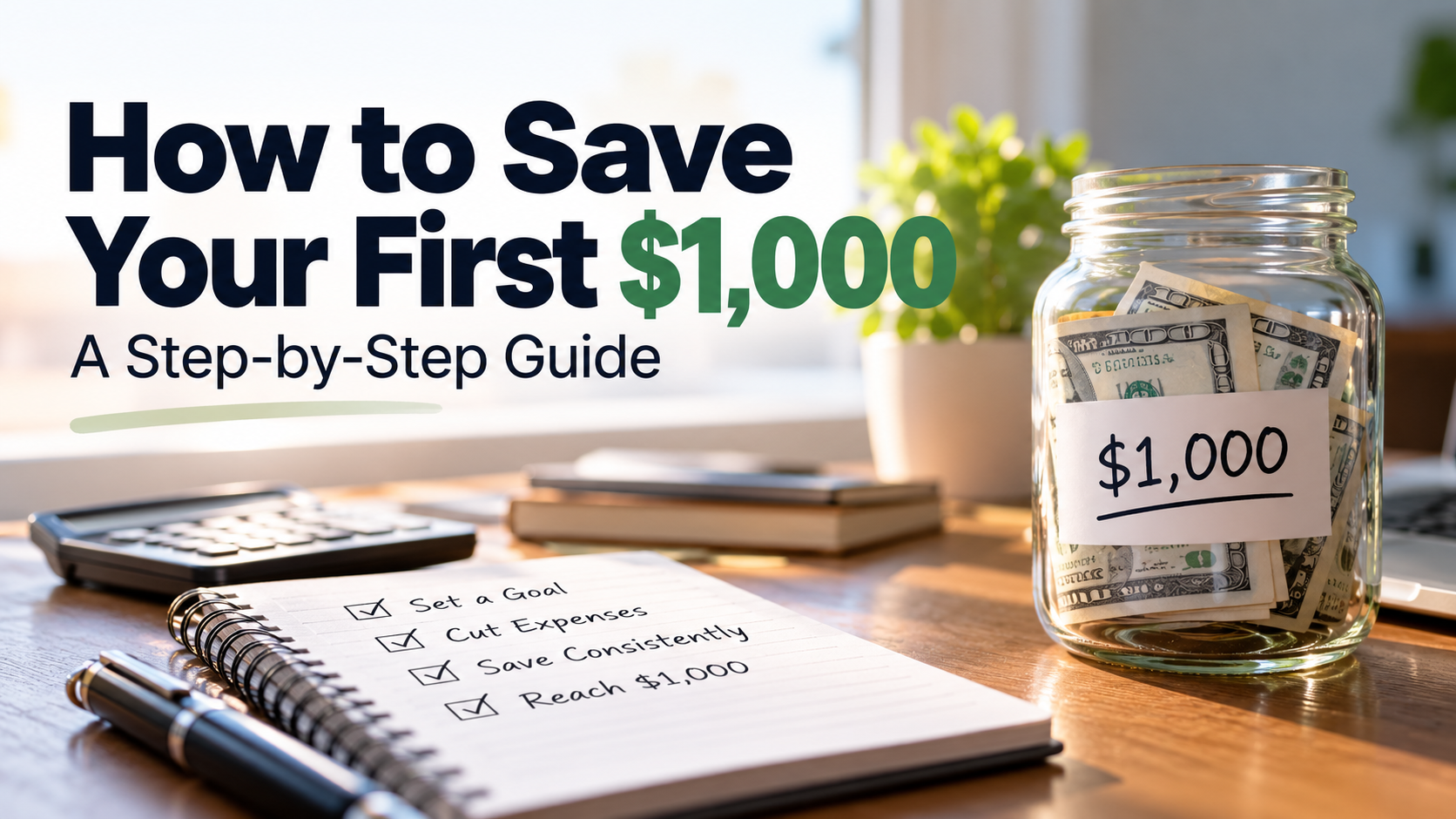
How to Save Your First $1,000: A Step-by-Step Guide
Saving your first $1,000 can feel difficult when you are starting from zero.
But you do not need a high income, a complicated budgeting system, or a perfect month to get there.
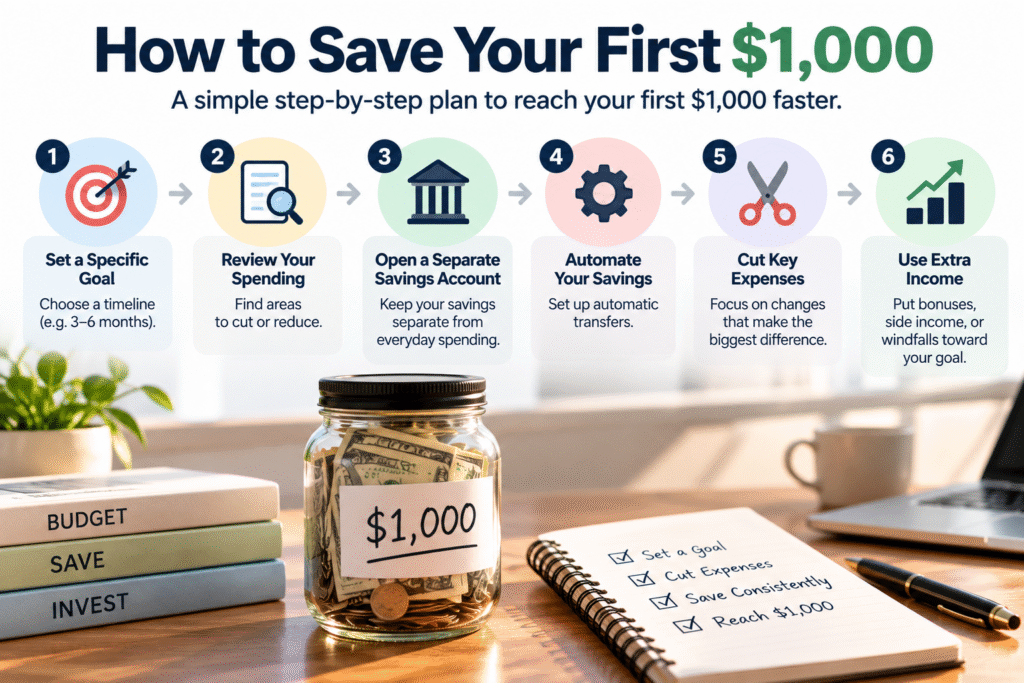
The easiest way to save $1,000 is to break the goal into smaller amounts, automate part of your savings, reduce a few meaningful expenses, and use extra income when possible.
For example, you could save:
- $1,000 in 2 months by saving $500 per month
- $1,000 in 4 months by saving $250 per month
- $1,000 in 5 months by saving $200 per month
- $1,000 in 10 months by saving $100 per month
Your timeline does not need to look like anyone else’s.
The goal is to create a savings plan you can actually follow.
In this guide, you will learn exactly how to save your first $1,000, how quickly you can reach the goal, where to keep the money, and what to do after you get there.
Why Saving Your First $1,000 Matters
Your first $1,000 is an important financial milestone because it gives you a small cash buffer for unexpected expenses.
It may help cover things like:
- A car repair
- An unexpected medical bill
- A broken appliance
- An urgent home expense
- An insurance deductible
- Unexpected travel
Without savings, even a relatively small emergency can end up on a credit card.
Your first $1,000 will not replace a full emergency fund, but it can give you more flexibility when something goes wrong.
If you are building emergency savings from scratch, this is a practical first target.
The Consumer Financial Protection Bureau recommends building emergency savings to help cover unexpected expenses and reduce the need to rely on credit or loans.
For a larger long-term goal, see our guide:
Emergency Fund: How Much Do You Really Need?
How Long Does It Take to Save $1,000?
The answer depends on how much you can save each month.
Use this formula:
$1,000 ÷ monthly savings amount = number of months needed
Here are a few examples:
| Monthly Savings | Time to Save $1,000 |
|---|---|
| $50 | 20 months |
| $100 | 10 months |
| $150 | About 7 months |
| $200 | 5 months |
| $250 | 4 months |
| $334 | About 3 months |
| $500 | 2 months |
Do not worry if your number is small.
Saving $100 per month consistently is better than trying to save $500 per month and giving up after a few weeks.
1. Set a Specific $1,000 Savings Goal
The first step is simple:
Decide when you want to reach $1,000.
Do not just say:
“I want to save more money.”
Instead, choose something specific:
“I want to save $1,000 within five months.”
Now the goal becomes measurable.
If your target is five months:
$1,000 ÷ 5 = $200 per month
If you are paid twice each month:
$200 ÷ 2 = $100 per paycheck
Suddenly, $1,000 does not feel like one huge number.
It becomes a series of smaller deposits.
2. Review Your Current Spending
Before deciding what to cut, find out where your money is already going.
Look at the last 30 to 90 days of bank and credit card transactions.
Group your spending into categories such as:
- Housing
- Groceries
- Transportation
- Insurance
- Debt payments
- Restaurants
- Takeout
- Entertainment
- Shopping
- Subscriptions
You are looking for expenses that can be reduced without causing financial problems somewhere else.
You may discover that you have $100 or $200 per month available already.
It is simply being spent on things you had not noticed.
If you do not currently have a budget, start with:
How to Create a Monthly Budget That Actually Works
3. Open a Separate Savings Account
It is usually easier to save $1,000 when the money is separated from everyday spending.
If your emergency savings and spending money are in the same checking account, it becomes harder to tell how much is actually available to spend.
A separate savings account creates a clear boundary.
Instead of seeing:
Checking account: $2,500
you might see:
Checking account: $1,700
Savings account: $800
The money has a clear purpose.
For a short-term emergency fund, focus on safety, accessibility, fees, and account terms rather than chasing the highest possible return.
4. Automate Your Savings
One of the easiest ways to save your first $1,000 is to automate the process.
Set up an automatic transfer every time you get paid.
For example, if you want to save $200 per month and receive two paychecks:
Transfer $100 from each paycheck.
If your target is $100 per month:
Transfer $50 per paycheck.
Saving automatically means you do not have to make the same decision every week.
It also helps prevent the common problem of waiting until the end of the month and realizing there is nothing left to save.
5. Cut the Expenses That Make the Biggest Difference
You do not need to eliminate every small pleasure to save $1,000.
Start with your larger flexible expenses.
For example:
Restaurant spending: save $100/month
Food delivery: save $60/month
Unused subscriptions: save $25/month
Insurance or phone plan reduction: save $40/month
Total:
$225 per month
At that rate, you could reach $1,000 in less than five months.
Focus on the changes that give you the biggest result for the least disruption.
6. Try a 30-Day Discretionary Spending Reset
A short no-spend challenge can help you save money faster.
For 30 days, avoid unnecessary purchases such as:
- Clothing
- Gadgets
- Food delivery
- Entertainment purchases
- Impulse shopping
- Nonessential subscriptions
You still pay for necessities.
The goal is simply to pause optional spending temporarily.
Suppose you normally spend $300 per month across these categories.
Redirecting that money to savings gets you almost one-third of the way to $1,000 in a single month.
7. Sell Things You Do Not Use
You may be able to save your first $1,000 faster by turning unused items into cash.
Look for:
- Old phones
- Tablets
- Gaming equipment
- Computer accessories
- Clothing
- Shoes
- Furniture
- Exercise equipment
- Tools
- Collectibles
For example:
Old phone: $200
Monitor: $100
Unused clothes: $100
Furniture: $150
Total:
$550
Now you only need another $450 to reach your goal.
Selling unused items can be especially helpful because it does not require reducing your normal monthly budget.
8. Use Extra Income to Reach $1,000 Faster
Savings do not have to come only from spending cuts.
You can also increase the amount coming in.
Possible sources include:
- Overtime
- Freelance work
- Weekend shifts
- Tutoring
- Pet sitting
- Delivery work
- Seasonal work
- Selling a service
Suppose your budget allows you to save $150 per month.
If you can also earn an extra $100 per month temporarily:
$150 + $100 = $250 per month
You could reach $1,000 in about four months.
9. Save Part of Every Windfall
Extra money can speed up your goal dramatically.
Examples include:
- Tax refunds
- Bonuses
- Cash gifts
- Rebates
- Refunds
- Overtime checks
Instead of deciding what to do after the money arrives, create a rule in advance.
For example:
Save 75% of unexpected income.
If you receive a $400 bonus:
$300 goes to savings
$100 can go somewhere else
This helps prevent extra income from disappearing through extra spending.
10. Use the 24-Hour Rule Before Buying Something
Impulse purchases can quietly slow down your $1,000 savings goal.
Try waiting at least 24 hours before buying nonessential items above a certain amount.
For example:
Under $50: normal decision
$50–$200: wait 24 hours
Over $200: wait 48–72 hours
During the waiting period, ask yourself:
Would I rather buy this or reach my $1,000 goal sooner?
You may still decide to buy the item.
The goal is simply to make the purchase intentional.
How to Save $1,000 in 30 Days
Saving $1,000 in one month is aggressive and will not be realistic for everyone.
But if your income and expenses allow it, you could combine several methods.
Example:
Reduce restaurant and takeout spending: $200
Sell unused items: $300
Extra work: $250
Pause nonessential shopping: $150
Reduce subscriptions and bills: $100
Total:
$1,000
The key is that you do not need to find $1,000 from one source.
How to Save $1,000 in 3 Months
To save $1,000 in three months, you need approximately:
$334 per month
One possible plan:
Automatic savings: $200
Reduced spending: $75
Extra income: $59
Total:
$334 per month
After three months:
About $1,002
How to Save $1,000 in 6 Months
To save $1,000 in six months, you need approximately:
$167 per month
Example:
Automatic transfer: $100
Lower discretionary spending: $40
Additional income: $27
Total:
$167 per month
After six months:
About $1,002
A six-month plan may be more realistic if your budget is already tight.
How to Save $1,000 on a Low Income
If you are trying to figure out how to save $1,000 on a low income, the strategy should be different.
Do not try to cut essential expenses just to reach the goal faster.
Instead, use smaller milestones.
Start with:
$100
Then:
$250
Then:
$500
Then:
$1,000
You may also need to combine small savings with occasional extra income.
For example:
Save $25 per week.
That gives you:
$25 × 40 weeks = $1,000
It takes longer, but the result is the same.
What If You Are Living Paycheck to Paycheck?
If there is almost no money left after necessities, look for both sides of the equation:
Reduce expenses + increase income
Cutting expenses alone has a limit.
You cannot reduce rent, groceries, utilities, and transportation to zero.
If your budget is already extremely tight, even an extra $50 or $100 per month of temporary income can make a meaningful difference.
Do not wait for the perfect financial situation before starting.
Even $10 or $20 at a time creates progress.
Recent Federal Reserve data helps put this challenge into perspective. In its 2025 household survey, 63% of U.S. adults said they could cover a hypothetical $400 emergency expense entirely with cash or its equivalent. That means a meaningful share of households still have limited room to absorb even a relatively modest financial shock.
Should You Save $1,000 or Pay Off Debt First?
If you have high-interest debt, paying it down is important.
But having absolutely no savings can create another problem.
A surprise expense may force you to borrow again.
One possible approach is to build a small cash buffer while continuing to make all required debt payments, then decide how aggressively to direct additional money toward high-interest debt. The appropriate balance depends on your interest rates, income stability, required payments, and access to other emergency resources.
The best balance depends on your interest rates, minimum payments, income stability, and other obligations.
Avoid thinking of it as an all-or-nothing decision.
Should You Invest Your First $1,000?
If this is your only emergency savings, investing the entire amount may not match its purpose.
Emergency money needs to be available when you need it.
Stocks and other investments can lose value in the short term.
You do not want to be forced to sell during a market decline because your car broke down.
Emergency savings and investments have different jobs.
Savings provide short-term stability.
Investments are generally for long-term growth.
Where Should You Keep Your First $1,000?
Your starter emergency fund should generally be:
- Safe
- Liquid
- Easy to access
- Separate from normal spending
A savings account or high-yield savings account may be worth considering.
When choosing an account, compare:
- Interest rate
- Fees
- Minimum balance requirements
- Withdrawal rules
- Deposit insurance
- Ease of access
At an FDIC-insured bank, eligible deposits are generally insured up to $250,000 per depositor, per insured bank, for each ownership category.
What Is a High-Yield Savings Account and How Does It Work?
We will cover this in more detail in our upcoming guide: What Is a High-Yield Savings Account and How Does It Work?
What Should You Do After Saving $1,000?
Reaching $1,000 is the beginning, not the end.
Your next step is to calculate how much emergency savings you actually need.
Suppose your essential monthly expenses are $3,000.
Your milestones might become:
$1,000 starter emergency fund
then:
$3,000 — one month of expenses
then:
$9,000 — three months of expenses
Your final target depends on your income stability, expenses, household size, and financial risks.
Read:
Emergency Fund: How Much Do You Really Need?
You can also use:
How Much Should You Save Each Month? A Realistic Guide
to decide how saving fits alongside retirement, debt repayment, and other goals.
Common Mistakes When Trying to Save $1,000
Waiting Until the End of the Month
Saving only what is left often means saving nothing.
Transfer money earlier when possible.
Trying to Save Too Fast
If your target forces you to use credit cards for basic expenses, the plan is too aggressive.
Cutting Only Tiny Expenses
Small purchases matter, but larger spending categories usually offer bigger opportunities.
Keeping Savings in Your Checking Account
Separating the money can reduce the temptation to spend it.
Ignoring Extra Income Opportunities
Cutting expenses is only half of the equation.
Even temporary additional income can accelerate the goal.
Spending the $1,000 on Planned Purchases
A vacation or new phone may be important to you, but those are usually separate savings goals.
First $1,000 Savings Checklist
Before you start, answer these questions:
- What is my $1,000 for?
- When do I want to reach the goal?
- How much do I need to save every month?
- Can I automate part of it?
- Which expenses can I reduce?
- Can I earn extra income temporarily?
- Where will I keep the money?
- What qualifies as an emergency?
Once you answer those questions, saving $1,000 becomes a concrete plan rather than a vague goal.
Frequently Asked Questions
What is the fastest way to save $1,000?
The fastest approach is usually a combination of reducing discretionary spending, selling unused items, earning extra income, and automatically saving part of each paycheck.
How much should I save per week to reach $1,000?
You would need approximately:
$19.23 per week for one year
$38.46 per week for six months
$76.92 per week for three months
Can I save $1,000 in 3 months?
Yes. You would need to save approximately $334 per month, or about $77 per week.
How can I save $1,000 if I live paycheck to paycheck?
Start with smaller milestones, reduce optional expenses where possible, and consider temporary ways to increase income. Even saving $25 per week eventually reaches $1,000.
Is $1,000 enough for an emergency fund?
It can be a useful starter emergency fund, but most people will eventually want a larger reserve based on their essential monthly expenses.
Should I save my first $1,000 in cash?
Keeping large amounts of physical cash is usually unnecessary. A separate savings account can make the money accessible while also keeping it away from everyday spending.
The Bottom Line
If you want to save your first $1,000, do not focus only on the final number.
Break it down.
Choose a deadline.
Automate part of your savings.
Reduce a few meaningful expenses.
Sell things you no longer need.
Use extra income when it becomes available.
Your first $1,000 may take one month, six months, or a year.
The timeline matters less than building a savings system you can continue using after you reach the goal.
Once you reach $1,000, you will have something more valuable than the money itself:
A repeatable process for building your savings.
Disclaimer: This article is for educational and informational purposes only and does not constitute individualized financial, investment, tax, or legal advice.